Author: admin
-
EPISODE 1
We’ll need a base from which we can jump. In our first inaugural episode we’ll just tell the tale as we know it.
-
The Story
Our story begins with Aristeus, the god of agriculture, shepherds, harvests and beekeeping. He noticed one day in the forest a beautiful and lovely nymph. She was beautiful with long curly hair, a dimpled smile and eyes that could look deeply into your soul. He’d spy on her from a distance watching her bathe in the cascades and dancing in the forest with the other nymphs. He wanted her. But he didn’t know how to approach her. For Aristeus was always busy ensuring things like a successful harvest and pollination. One day he decided he would appear before her to propose a courtship, but as he did there was a sudden sound.
It was the sound of a beautiful lyre playing in the forest. He wasn’t the only one who heard it. He watched as Eurydice noticed it as well. Curious, she followed the lyre to a spread on the forest where several animals appeared to be kneeling before this handsome man before her. Her lips smiled and her eyes gleaned in fascination. It was the most beautiful music she’d ever heard. He was the most beautiful man she’d ever seen.
Orpheus, son of Apollo, liked to play his lyre in the forest. His father Apollo could play the lyre, but Orpheus didn’t have the responsibilities of his father, and so with his free time he easily surpassed his father’s ability. He was so good, that animals would come to listen and the trees and brushes would animate and lean towards the harmonious sounds.
Orpheus stopped playing when he saw a hand clear the brush and the beautiful nymph stepped out.
“Please,” she said. “Keep playing.”
She sat upon a fallen branch, crossed her legs and rested her head upon her fist, intently eyeing Orpheus and his lyre. Her smile wasn’t just infectious. For when Orpheus returned the smile he realized that he was sitting across from his person. His love. His home. His forever. Eurydice was her name. A stream of excitement pulsed through the demigod and he directed it into his lyre. Playing notes, and harmonies that transmitted his love for all to hear.
He continued to play, with Eurydice tapping her foot, feeling the tune reverberate as such to warm the heart of the nymph and enchant her senses. When he was done playing they just looked at each other momentarily. She approached him, never taking her eyes off him, wanting to see the lyre up closer, to see Orpheus’ hands that managed to produce such a tune. Her bare arm underneath her tunic made contact against Orpheus and they both immediately felt flushed with warmth.
It was love. And not just any love. It felt predestined. As if time itself had planned for Eurydice to hear Orpheus and find him in the forest. Orpheus was this beautiful handsome magician, and Eurydice’s beauty was the embodiment of goddess-like perfection.
She inspired him to play beautifully. In turn she was honored and proud to be the pair to a master magician and the son of Apollo. They were inseparable. Eurydice never tired of hearing Orpheus play his lyre. She would gaze at the content faces of all those who might hear him, knowing that the sounds were created from her partner. Sometimes she didn’t want to share so whe took him to some of the most beautiful guarded and secluded cascades and treasures in the forest for inspiration. When he wasn’t playing they could talk for hours, make love and simply walk. It was as if they couldn’t know enough about each other, they couldn’t touch enough of each other, they couldn’t see enough of each other. Every detail regardless of how minimal, whether it be the bracelets Eurydice liked to wear on her wrists, or the shy smirk Orpheus gave whenever meeting one of Eurydice’s friends or family. His restrained laugh. Where once there was Orpheus son of Apollo the master lyre player, and Eurydice the beautiful forest nymph, there now was simple Orpheus and Eurydice, for you couldn’t be with one without there being the other.
Their families took notice quickly. And it was no surprise when Apollo and Eurydice announced their intention to marry. With Orpheus having a father with connections at the highest levels of Olympus, and Eurydice being the ever-beloved social nymph, their wedding was to be one of the grandest festivities ever. They were even able to obtain the blessing from Hymenaeos, god of marriage, although he warned that the “harmony of their matrimony wouldn’t last.” It’s interesting how elder gods seem to know these things, but they never actually intervene, isn’t it? Orpheus and Eurydice were unphased.
And so the day comes and indeed it is the grandest of weddings ever. There are flowers, singing, dancing and music. The forest trees are in full blossom. This is a love between these two that feels as warm as the sun, as timeless as the earth’s rotations. The scene was overflowing with overjoy. Everyone was happy for the couple. Everyone yearned for a love like theirs.
Everyone except for one person.
Aristeus watched scornully from a distance camouflaged behind a patch of trees. How could he, a mortal god, be so ignored? It seemed preposterous! He’d done so much for mankind, afterall. Just as Hercules had gone on epic adventures, he too had a long list of merits. He’d diverted water to droughts. He’d provided the greenest pastures upon which sheep could graze. He’d infused fertilizer to the most barren of soils. He’d even managed to coax harvests in the most abnormal and cold years. He was convinced he deserved a beautiful wife such as Eurydice based on his merit alone, and yet she….. SHE…. goes and simply throws herself aimlessly at a lyre playing son of Appollo.
Seeing the happiness and the gloating of all of the wedding goers threw him into a fit of rage that he was unable to control. To Aristeus, it was clear, Eurydice didn’t know what was good for her. Clearly she’d made a mistake. So, logically, he decided he’d simply take her and ravish her.
In a poof, Aristeus appeared in the center of a dancing circle. He immediately lashed out and grabbed Eurydice by the arm yelling, “This is preposterous! You’re mine and I shall have you!”.
Orpheus grabbed his wife away from the clutches of this lesser mortal of domesticity and they both fled into the thicket of the forest.
“Just run,” he told her. “Run with me as fast as you can.”
As the ran, there was the sudden hiss and shake from the ground beneath Eurydice’s feet, and a lunge of a snake lept forward and dug its fangs into her leg the wounded snake writhed and recoiled away.
“Orpheus!” she shouted. “Stop! I’ve been bitten,” she exclaimed.
Her run hobbled to a stop as she fell to the ground and grasped her affected leg. Perhaps it was the adrenaline of the blood pumping through her body that made the venom quickly take hold as soon Eurydice’s body went limp and her breathing became erratic.
Aristeus, upon seeing the mishap he’d caused slipped away back into the cover of the forest and would speak nothing of this to anyone ever.
By the time the wedding goers caught up they found Orpheus sobbing uncontrollably as he mercilessly clutched Eurydice’s limp lifeless body.
As we all know the first stage of grieving is denial and Orpheus was no exception. There’s simply was no way she could be gone. He’d still awake from his sleep and groggily think she’d still be laying by his side. The painful realization that she wasn’t was unbearable. He had just married Eurydice. She was his person, his love, his eternal return, and in an instant she was gone. Suddenly Orpheus felt isolated. For Orpheus it was the most cruelest of cruel cruel jokes. How could the world could give him everything and in an instant leave him in silent empty abandonment.
To express his grief he did the only thing he could do. He played his lyre. So sad was the tune he played that all of the gods and mortals alike could here the depths of his sorrow. The lyre’s tunes brought forth a fog and damp darkness that presided over Orpheus and all those around him.
His friends tried to comfort him but so imprisoned in his grief was he that he couldn’t even hear the words they’d say. In seeing his agony, his friends also realized there was little that could be said to ease such despair.
It was this overhanging dreadful cloud that made Apollo listen to his son when he approached him.
“I want her back,” Orpheus told his father. “I have to have her back. It was a fluke. She should’ve never been taken.”
Apollo listened to his son earnestly and with compassion.
“I understand,” he responded. “I’ve seen the passing of mortals since time immemorial. It’s imprudent and disingenuous when we try and disavow ourselves of the order established by the old Godst. It never goes well. Death is one of the greatest promises among mortals. SO strong a promise that we as immortals are forbidden to break it as well.”
Orpheus fell to his knees in despair.
“Please, father. I beg of you. I want her back. Bring her back to me.”
“She’s with Hades, Orpheus. The underworld is a one way door. There’s no coming back. I’m sorry.”
“Then let me speak with Hades, your uncle, and convince him otherwise. I’ll play for him. Just please tell me how to get to him.”
Apollo sighed. He knew there was no convincing his son otherwise.
A few days passed and, in the dead darkness of night, Orpheus did as his father instructed and he met with Hermes, the messenger god, who would bring him to the River Styx.
“You have your lyre, I assume?” he asked.
Orpheus lifted his tunic to reveal the golden harp he stored under his arm.
“Good,” said Hermes. You’re going to need it. “Keep your hood up. Try and act dead so the dead don’t get suspicious when they see you.”
And so Hermes rowed the boat with Orpheus until reaching an outpost. Charon the ferryman came out.
Charon immediately sensed something was off. Hermes never arrived with just one. It was always a full boat of souls en route to go under.
“Whom have you brought?”
Hermes motioned to Orpheus to remove his hood which he does.
“Blasphemy!” Charon exclaimed at seeing the living corporeal man. “Hermes I can’t! There’s no way! He’ll (referring to Hades) will be furious. He’ll have my head.”
Again, Hermes, motioned to Orpheus.
Orpheus took out his lyre and began to play. Immediately Charon was put in a trance. It was the most beautiful and sad playing he’d ever heard. So beautiful was the playing that it dissolved his worries. Although, reluctant, he went ahead and invited Orpheus to board his boat.
Just keep your head down and always covered. We can’t have the dead knowing there’s a live man entering the underworld. This world is not meant for the living. We can’t have the souls here thinkin’ otherwise.”
“I’ll do everything you ask. Just get me to Hades.”
“He could use some entertainment I suppose.”
And so Charon and Orpheus slowly rowed through the underworld down the river Styx, passing the myriads of floating souls who peered beadily at the sole passenger of Charon’s boat. The chorus of their floating voices stirred around Orpheus penetrating into his psyche, making him nearly disoriented and unaware of what direction was up and down or front and back. It was unclear whether the boat floated on water, or if it glided on air. Directionality and dimension simply had no use here. He fought to remain steady as the pangs of emptiness and the infinite void of the universe and the absence of time itself loomed ever real around him. There were no voices, but rather a chorus of spirits churning like wind.
“Just stay steady,” Charon said reassuringly. “Like I said, this is no place for the living. We don’t have much further to go.”
Into the distance a large dark ledge could be seen. Underneath it a large gate that slowly opened. The boat passed through slowly and then it stopped. Or did it? The darkness and stillness that surrounded made it feel as if the boat was levitating as opposed to rowing. Suddenly, as if out of nowhere, a dock appeared and Charon dropped anchor. Charon stepped onto the dock and reached his hand out to assist Orpheus.
“Almost there.”
And so they walked up some winding stairs, walking over under all over them until suddenly they reached a pantheon that adorned dark and emptiness just as others might boast gold and statues. From the rock and darkness a large foreboding figure turned around faced the two men.
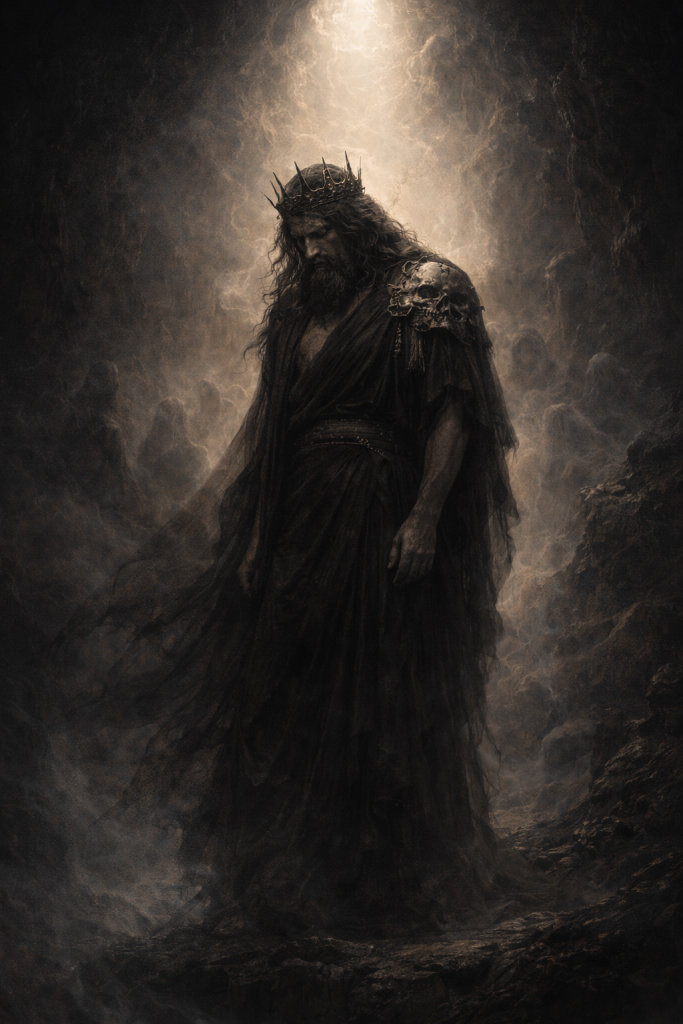
“Charon, explain this. Now. Why have you brought a living soul here. What possessed you to commit such an insult?”
Orpheus threw his hand in front of Charon signalling it was his moment now.
“Forgive Hermes. I am Orpheus, son of Apollo.”
Hades took two steps forward as if to get a greater look at his nephew which moreso allowed his harsh profile and thick beard to be seen more visibly. Orpheus suddenly felt nervous.
“But why would the son of Apollo, a seeker of light, send his son here?”
“Because I’ve lost someone. Eurydice. She was my wife.”
Hades was silent for a second.
“I’m sorry, Orpheus. You can’t have her back. She belongs here now.”
“I shall make a deal with you.”
“Oh? Is that so?”
Orpheus removes the lyre from under his tunic.
“If I can play you a music that is the most beautiful music you’ve ever heard then YOU my dear uncle will allow her to come back with me.”
“The most beautiful music I’ve ever heard? As good as that of your father?”
“Better.”
With his innocent youthful zeal Orpheus takes out his lyre and begins to play it. The forlorn and reluctant king of the underworld’s shoulders lowered and he sat upon a nearby stone as if to take it in more intensively.
When Orpheus finished he waited for Hade’s approval.
“It’s always nice to hear the music of the living world,” he said after exhaling deeply. “Indeed it’s the most beautiful music I’ve ever heard.”
Orpheus beams with pride.
“You’ll let me take her back, uncle?”
Hades stands up and begins to pace away from the rock.
“YES,” he states.
With that Orpheus nearly gasps in delight. “Oh thank yo-”
“But WAIT! There are to be conditions,”
“Tell me what they are. I’ll do whatever you say.”
“Very well,” says Hades as he waves his hand. A large door opens up to a tunnel.
“I’ll allow you to walk out of the underworld through this tunnel. She will follow right behind you. BUT until you have fully exited the underworld, DON’T LOOK BACK. Under no circumstance should you look back. For if you do, you’ll lose her.”
Hades motions Orpheus towards the tunnel.
Orpheus reluctantly begins to enter into the tunnel, somewhat relieved he gets to leave on solid ground rather than the tilter world of the boat in which he arrived.
“Go on,” urged Hades. “She’ll be right behind you.”
[Advertisement Break]
And so Orpheus slowly with trepidation entered the tunnel.
It was dark with just barely enough light shining near the end to allow for him to make out the confines of the dark rocky texture of the tunnel around him.
He proceeded forward just hearing the echo of his own footsteps only hearing the echo of his own footsteps. He recalled the Hade’s condition. Don’t look back.
And so he kept his forward. And then suddenly faintly every so quietly he heard the most delicate of footsteps behind him. His heart beat skipped and accelerated.
“Eury? Is that you?”
But there was just silence. So he stopped for a moment. The the footsteps behind him stopped in turn.
“Eurydice?”
Again, no response. But he kept walking forward ecstatic at the possibility of returning Eurydice to the land of the living.
But suddenly there was a shift. As he walked the faint footsteps became dimmer. Until suddenly he heard nothing at all.
He stopped momentarily. But he heard nothing.
And so he continued down the dark corridor that illuminated more and more with each step as he advanced towards its finality as the realm of the living took hold like trees overtaking a desert.
But the silence and uncertainty grew maddening. Had he lost her? Did she stop and not continue? Should he have stopped? Don’t look back, Hades had said, but the end was almost there just within reach. Would he reach the end without her?
And so he stopped again.
“Eurydice talk to me. Can you hear me?”
But there was no response. She wasn’t there he was sure of it. He needed to make sure she was okay. His protective instincts and his uncertainty all suddenly collided like a big ball of confusion.
He did the unthinkable. He looked back.
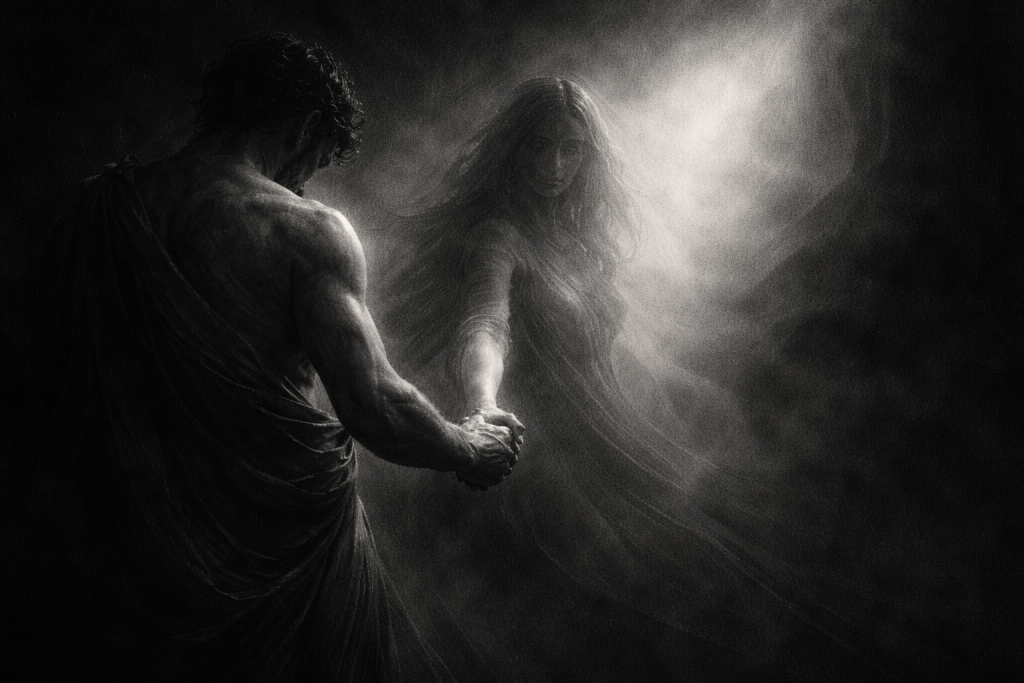
Wide eyed and scared he saw Eurydice, trying to scream but no voice emerged. She reached her hand out, but her body suddenly faded bit by bit as she repeatedly tried to shout and grasp at Orpheus. Orpheus tried to reach back at her, hoping he could grab her just in time and pull her out of the tunnel.
It was no use. Her corporeal image dissipated back into the dark recesses of the tunnel.
Orpheus fell to his knees and screamed for Eurydice. She never came back.